

Description
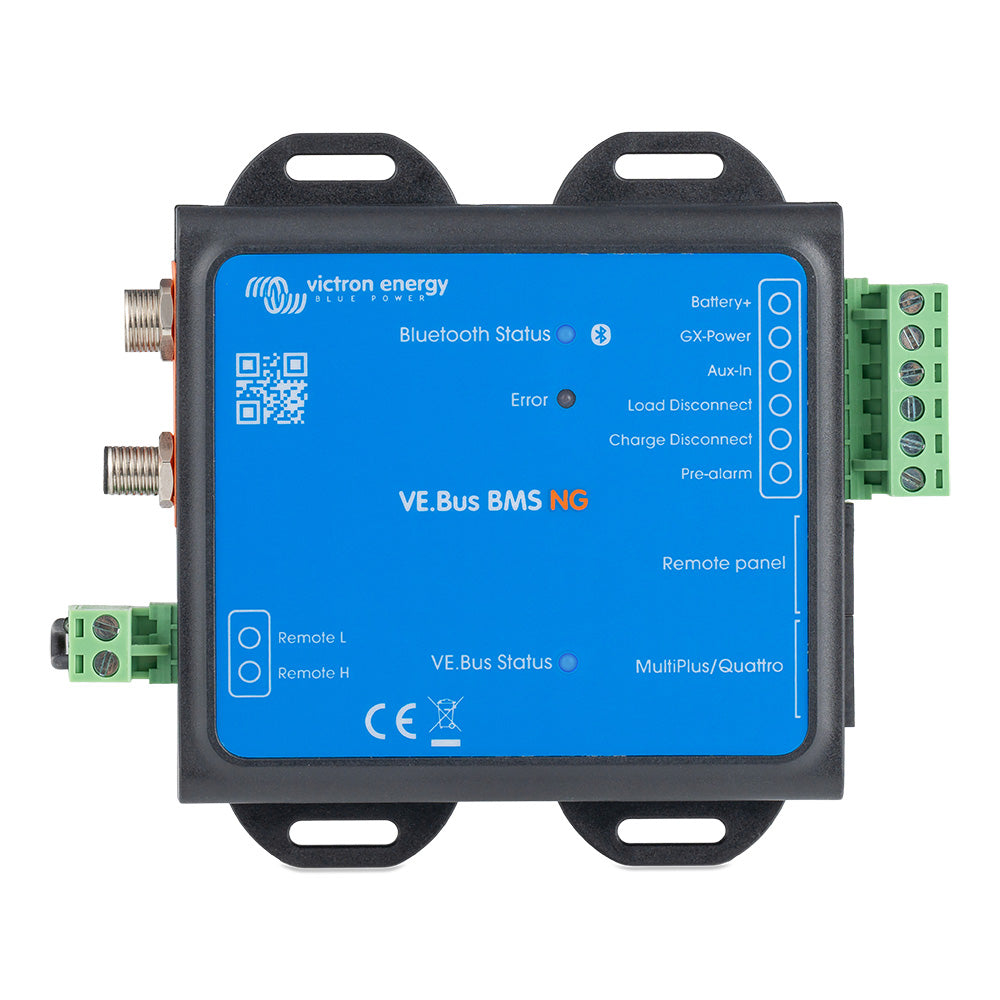
The Victron VE.Bus BMS NG is an all-in-one battery management unit for Victron Lithium NG battery banks. It suits systems that pair Victron inverters or inverter/chargers using VE.Bus communication. It watches each cell for overvoltage and under-voltage, and also guards against over-temperature and under-temperature conditions.
Features
- Watches each battery cell for overvoltage and under-voltage, plus over-temperature and under-temperature conditions.
- Built-in Bluetooth links all lithium NG batteries in the system for central monitoring in VictronConnect.
- Takes current and state of charge data straight from the batteries, so a separate SmartShunt is not needed.
- Series, parallel or mixed battery banks at 12V, 24V or 48V; a maximum of 50 batteries in 12V or 24V banks and 25 in 48V banks.
- Load disconnect output drives the remote on/off input of a BatteryProtect, inverter, DC-DC converter or other load to prevent deep discharge.
- Charge disconnect output controls the remote on/off port of chargers such as the Smart IP43 Charger, to prevent overvoltage.
- Pre-alarm output gives early warning of low battery voltage and can drive a relay, LED or buzzer.
- Blue LED shows Bluetooth status; red LED shows warnings and errors.
Specifications
| Brand | Victron Energy |
| Manufacturer part number | BMS300200300 |
| UPC | 8719076063520 |
| Battery type | Victron Lithium NG batteries |
| System voltage | 12V, 24V, 48V |
| Maximum batteries | 50 in 12V or 24V banks; 25 in 48V banks |
| Maximum storage | up to 192 kWh (12V), 384 kWh (24V), 128 kWh (48V) |
| Bluetooth | Built-in Bluetooth Smart |
| Outputs | Load disconnect, charge disconnect, pre-alarm, remote on/off control |
| Weight | 0.65 lb |
| Box dimensions | 2″H x 5″W x 7″L |
Compatibility
The VE.Bus BMS NG is made for Victron Lithium NG batteries and is not compatible with Lithium Battery Smart batteries. It is designed for systems with Victron inverters or inverter/chargers using VE.Bus communication. Multiple Lynx Smart BMS units can be paralleled to expand capacity and ensure redundancy.